The rhubarb that I planted in pots before we moved last year has overwintered safely in a corner of a barn. This probably wasn’t essential but for our first winter in the North Pennines I wasn’t sure what to expect!
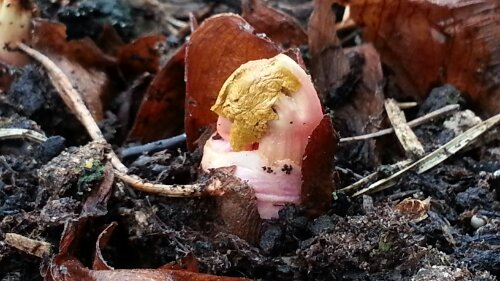
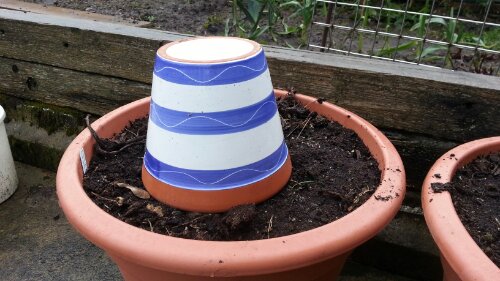
Both the Stockbridge Arrow variety and the Champagne variety are looking quite healthy considering the neglect of the last few months. Once I saw that there are already some signs of life I thought I’d try gentlyforcing them this year.
Forcing is not something I’ve tried before and these were only planted into the pots last spring so I don’t want to push them too hard. On the other hand I want to see how it goes while they are still in pots because I plan to put these plants into an old vegetable bed next year.
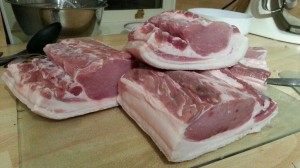
This was just a gentle introduction to bacon curing and sausage making although just before Christmas there was also a flurry of curing ham as well but the process for that is actually much the same as for bacon. It might be just plain beginners luck but these turned out well and the results were very well received over the Christmas period!
Another burst of sausage making only yesterday reminded me of a couple of extra points which I have now included but I’m sure there’ll probably be a few more additions or changes as time goes on.
The Processing Pork page has been added mainly as a reference for the methods and recipes used this time around so that I can look back at the information when our next lot of weaners arrive back from the butchers. If this page also helps others as well then that’s a bonus and if there are any glaring errors or omissions then please let me know so I can correct them!
There is a growing feeling that we are almost through the short days and long dark nights of winter. The time is almost here to focus on planning for the coming year, drawing up a planting plan and trying to get one step ahead before everything starts growing again.
I’m ready for the late burst of winter (if it comes) and I’m actually hoping for a bit of snow so I don’t feel like the winter tyres I bought have been a complete waste of time.
Raised Beds
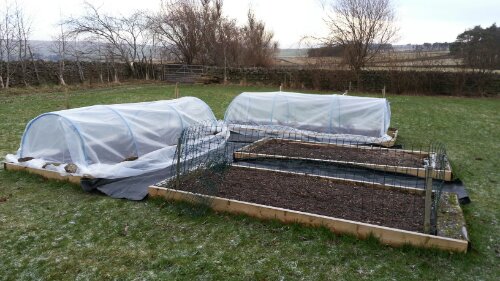
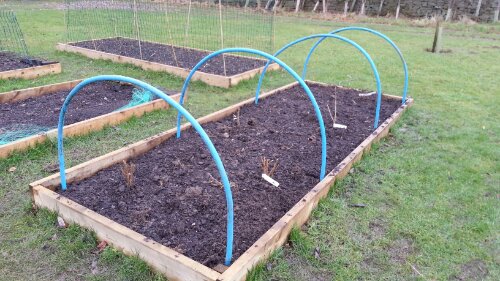
The addition of plastic covers over a couple of the raised beds has generally been a good idea and at the very least it kept the chickens off the onions and garlic.
It took me a while to decide how best to fix everything as I had grand hopes of inventing some sort of home-made cover which would be both removable and adjustable. That simply resulted in indecision so nothing was done but eventually I gave up on the fancy plans and decided to simply attach wooden battens down each side.
An important lesson learned however is to give some rigidity to the structure by bracing each of the hoops along the length of the raised bed. Without this the ends of the cover simply fold in when you attempt to get any tension in the plastic. The two smaller raised beds have deliberately been left without covers but even so more timber is needed to complete the fixing work job!
Covered raised veg beds
The fixings have so far proved very successful and are definitely more visually appealing than a pile of old stones and rocks. The next task is to finish pegging out the ground cover fabric along the pathways and cover it with some stone chippings or gravel. With something like 30 metres of paths to layout, edge and fill I think there will soon be another sizeable delivery coming from the local builders merchant.
Solar PV
Despite the predictions of delays with planning applications, barely a couple of months after applying the approval came through. As expected there were no major concerns from anyone so now the work can go ahead as soon as possible – just in time for the weather to improve in spring. I hope these solar panels don’t put a jinx on summer this year!
The idea of ground mounted solar panels (instead of roof mounted) made the most sense for our situation especially given that the main house roof is east/west-facing. The only suitably south-facing area of roof is on a barn but that was considered to be a little too shaded by trees growing close by. Those trees are definitely staying as they include a few healthy looking ash trees which I’d hate to lose.
I believe that the next major hurdle to tackle will be completing the FIT (Feed In Tariff) forms for our electricity supplier but I’m not absolutely certain about that. Up to this point the panel installation company have been very helpful so I’m sure they’ll be able to guide us through the rest of it.
It was hardly surprising that just over 50% of the chicks that hatched turned out to be male. Unfortunately with their growing maturity this has led to incidents of “unacceptable behaviour” with boys either fighting each other or pestering the hens.
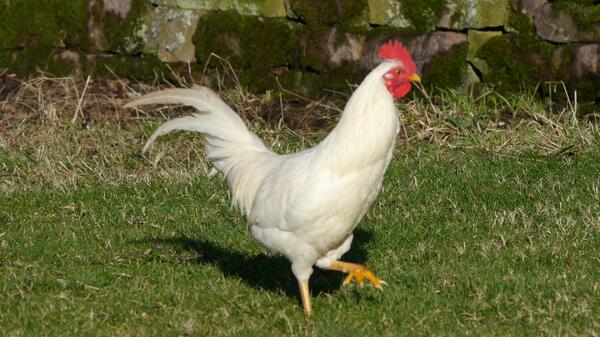
A fine looking specimen
Another helpful lesson that has been learned is that raising chickens for meat is fairly straightforward but the actually killing doesn’t get any easier no matter how many times you do it. I can still recall the one that had been strung up by his feet after being killed only for me to turn around a minute later to see him walking away down the barn!
Perhaps if someone else dealt with the dispatching, plucking and gutting then it might be worth considered in the future. Of course whoever did this would need to be paid and that would most likely cancel out any financial gain!
Longer Days
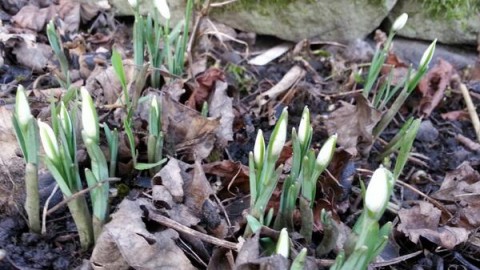
Each morning is just a little lighter than the last, the snowdrops are already up and the daffodils are starting to push through the remaining fallen leaves and other detritus that we left. This was not a scientific decision to warm the ground for spring, it was more a case that we never got around to clearing it all during autumn/winter!
Snowdrops
The temptation is still to look too far ahead in the impatience for spring to arrive. Instead I turn the statement around and try to remember that there’s nothing I can do it stop spring arriving in the end and it will get here soon enough.
Since we moved here less than a year ago, each month brings new things to see, learn or do. We’ll never remember everything but hopefully that’s where this blog will go some way to assisting in future years.
This will be our first spring here so it is eagerly anticipated to see what it brings with lambing, more weaners and getting to grips with the new raised beds. Exciting times ahead!
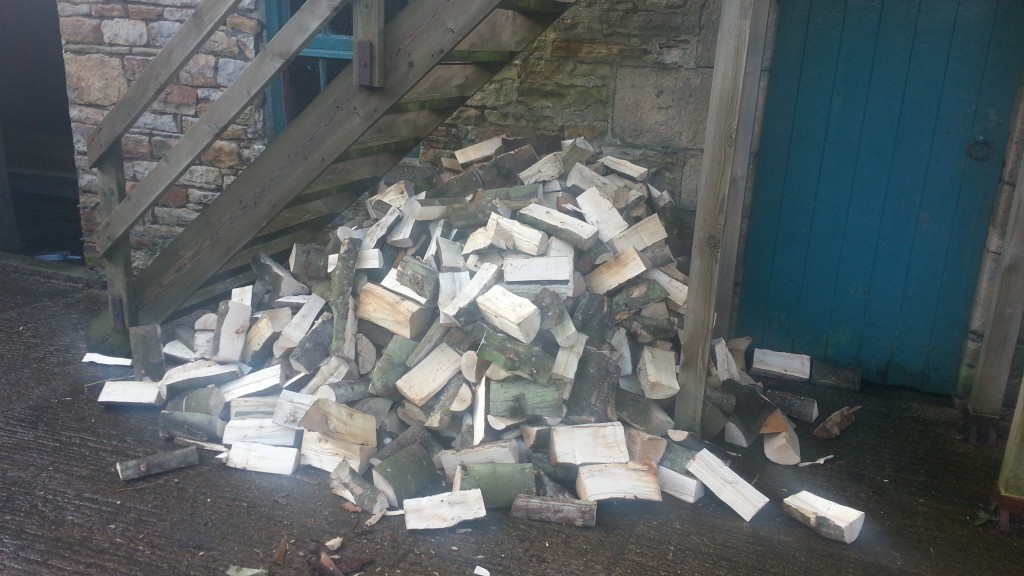
Any prospect of the lazy Sunday afternoon that I thought might have been possible was quickly dispelled by the unexpected arrival of the log man. Apparently he was catching up on deliveries after suffering with a bad cold recently but this kind of service seemed above and beyond the call of duty!
Firewood delivery
A very welcome sight of course as our supply of logs was pretty much all gone and recently we have been burning the “left overs” that had gathered in odd corners of the wood shed. I’m not sure if there is a term which can be used for firewood found like this but “driftwood” doesn’t seem quite right.
Unfortunately for me, everyone else had somewhere else to be on Sunday afternoon so it meant that I had the pleasure of shifting this little lot into the wood shed. In the end it turned out to be a pleasant enough task especially once it was completed despite the dull ache from all the bending and lifting.
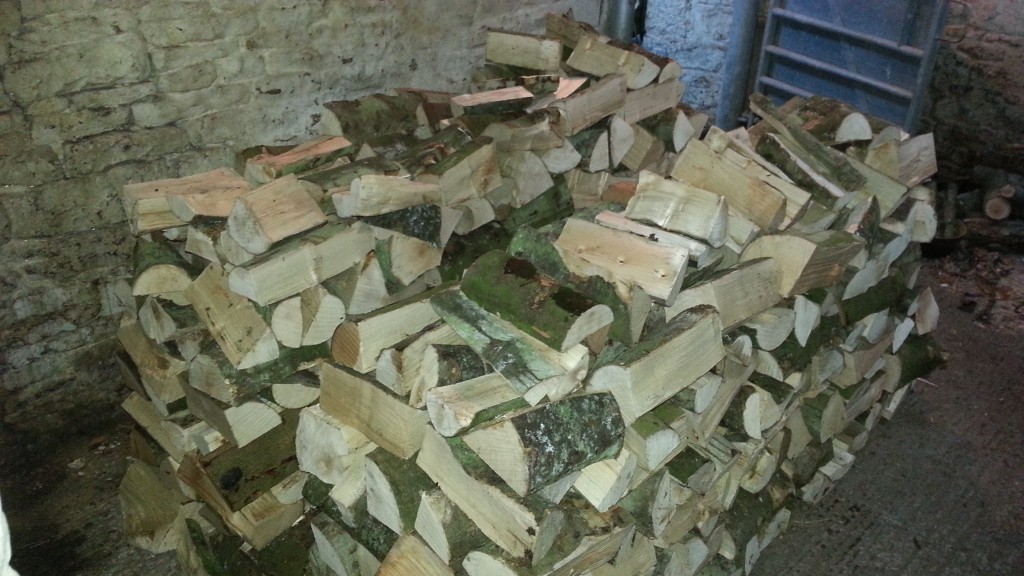
There is something very satisfying about a neatly stacked wood pile even though I’m not sure whether I’m doing it the right way – hopefully there isn’t a “right” way which would obviously mean that I can’t be doing it “wrong”!
Smart wood pile
One thing was clearly highlighted though while doing this, a new wheelbarrow is definitely near the top of the shopping list. The existing one has another flat tyre and I can’t bear to go through the aggravation of mending punctures and replacing the wheel again! At least I got two years use after the previous repair efforts and I can always keep this one for emergencies only.
I couldn’t help myself this morning, I spotted on Twitter that there was a one day 30% off promo code (TWITTER30) with SeedParade.co.uk (@SeedParade) so I figured I might as well give them a try this year. I’ve not used them before but they seem to have a fairly good selection (although no seed potatoes).
The deal was only valid for today (Fri 24 Jan 2014) but I had been contemplating the list of seeds to get for a few weeks so I was ready to place an order with someone.
Although the list looks fairly extensive when I read the email confirmation, the idea was to try a good variety of things that we would eat to get a better idea of what works here. I also don’t have to plant all the seeds from every packet I’ve bought so I could keep some for next year – I doubt that will happen though!
This years efforts should give a better guide for future years than my limited efforts during the last half of 2013 so that I don’t waste time on crops that simply don’t suit the site, environment or soil conditions.
The vegetable seeds ordered, in no particular order:
Dwarf French Bean Tendergreen
Beetroot Boltardy
Leek Giant Winter
Pea Purple Podded
Swede Marian
Sweetcorn Sweet Nugget F1
Carrot Nantes
Lettuce Cos Little Gem
Courgette Early Gem F1
Winter Squash – Waltham Butternut
Cabbage January King
Parsnip Countess F1
Cabbage Red Drumhead
Plus there were also a few herbs as well for variety:
Chamomile
Chives
French Lavender
Rosemary
Greek Oregano
Hopefully with a bit of careful planning and a little succession sowing I can try out some of everything I’ve ordered this year. There might be a slight space problem (as usual) but with 4 new raised beds already and one more that could still be built I think everything might work out okay.
My next job is working out what will be planted where and when…
After a dull, rainy day on Saturday the better weather on Sunday afternoon meant a burst of activity was both necessary and unavoidable.
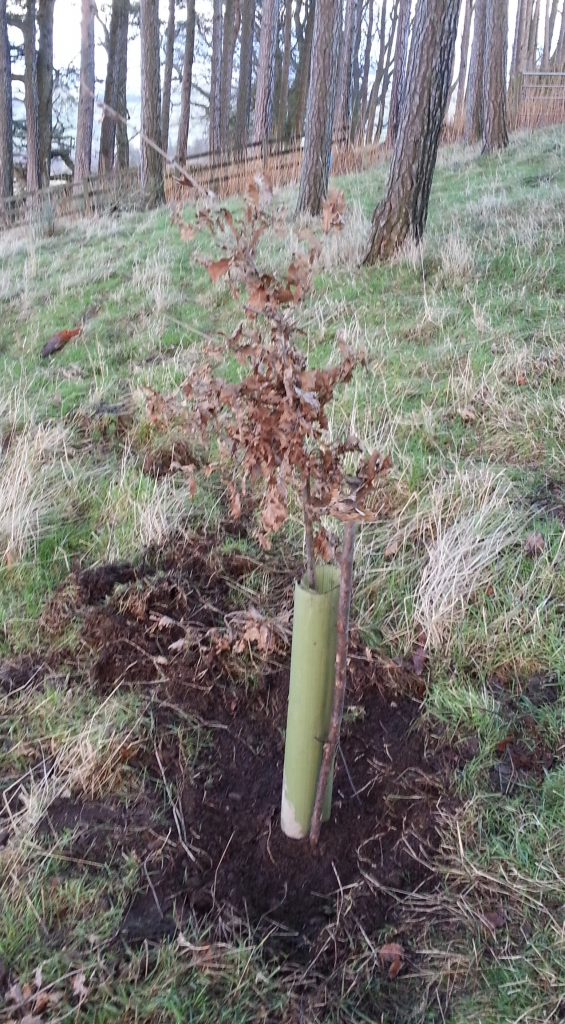
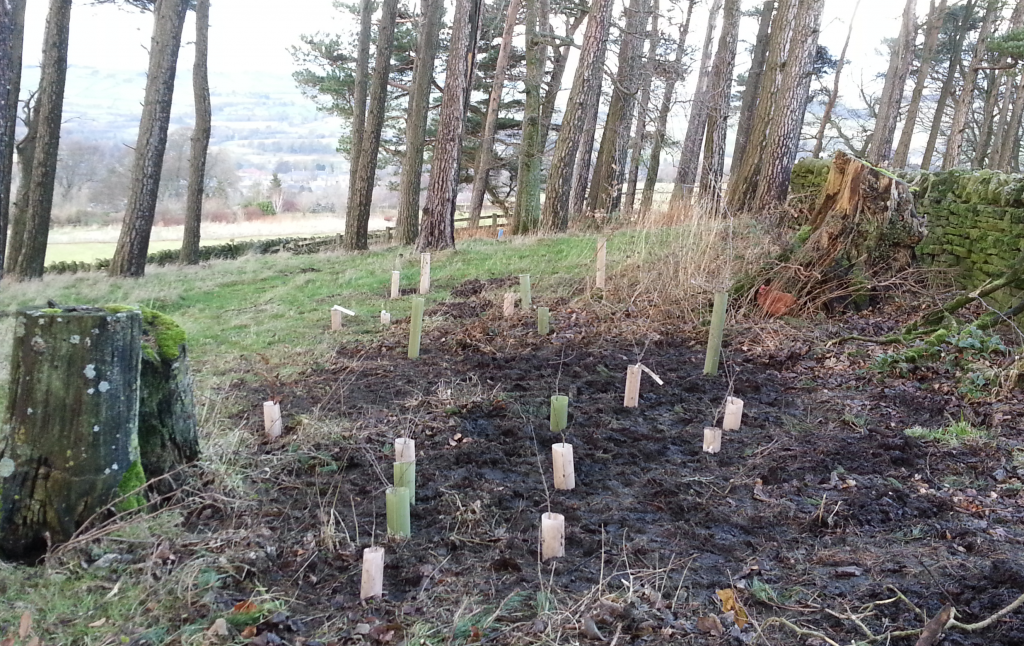
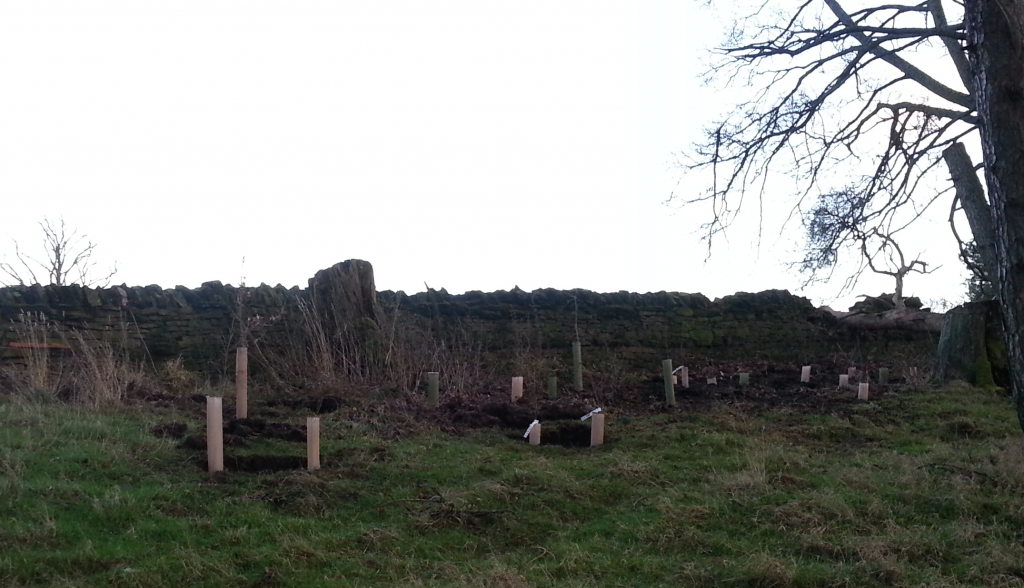
Finally the trees that had been collected the week before could be planted after spending a week in their bags in an outbuilding.
As bare root plants, I suppose they might have lasted one more week with a quick check and maybe some water on their roots but I’m much happier now knowing that the job has been done.
This first batch was intended to provide some much needed diversity to the existing shelter belt by adding some more native broad-leaf trees. There are already quite a few very old beech and oak trees but far more larch/pine which are getting past their best.
For those with a more detailed interest in trees, this order consisted of the following:
8 x CRATAEGUS MONOGYNA (Hawthorn)
4 x FAGUS SYLVATICA (Common Beech)
4 x QUERCUS ROBUR (English Oak)
5 x BETULA PENDULA (Silver Birch)
3 x BETULA PUBESCENS (Downy Birch)
From my point of view, one of the unexpected joys of planting trees for the first time was the slow realisation that all your work will take years to develop which is such a contrast to the more immediate gratification of planting vegetable seeds.
It has been suggested that some of our trees are well into their second century which puts day-to-day life into perspective a little!
Most of this new planting was to fill an existing gap where some older trees had obviously come down long ago but never been replaced. A couple of the English Oak were planted elsewhere though to fill out some spots before any gaps develop.
Time will tell how successful my efforts have been (a great deal of time in fact) but by the end of the afternoon I was certainly glad the work was finished!
Filling an empty patch of woodlandA gap waiting to be filled
Despite having started constructing the raised veg beds back in October, further progress has been a little slow due to the high number of distractions in the intervening months. One thing is becoming very clear since we moved here, it’s all too easy to find yourself with many projects started but none fully completed!
With these new raised veg beds, the intention was always to come up with some covers to help extend the growing season but initially I had no particular approach in mind. Finally the delays got to me so I ordered some supplies from Premier Polytunnels including a decent length of polythene to use as a cover.
At the same time, I took the opportunity to order a decent length of ground cover fabric to go in between the raised beds. It seems wise to get that in place sooner rather than later!
In an earlier post I showed the first stages of adding the water pipe hoops on one of the raised beds but with an hour or two to spare last weekend I finally completed the work on two of the four raised beds. This new area alone is more growing space than I had in the last house never mind the original vegetable bed here which is also expected to be fully utilised this year.
Polythene covers in place
At least I can relax now if the chickens decide to invade the garden because the onions and garlic (on the left) and soft fruit bushes (at the back) are suitably protected. The onions in the nearest bed will just have to take their chances for the moment with a low fence around them – it seems that the chickens can’t be bothered to flap over that.
There is still some final work needed to properly tighten up the covers so that they can survive any bad weather but I’m still contemplating the best way of attaching the polythene to the raised veg beds. I’d like to make it completely removable if possible but perhaps it’s better to just attach it on one side so that it can be rolled back if needed.
Further ideas
There was always plans for another raised bed in this area but I’m inclined to hold back on that in case I take on more than can be properly managed in the coming year. Having said that, I usually buy far too many seeds each spring so I may hurriedly build something once I’ve filled up all other available space.
It will probably be best to completely fence off this new growing area – to prevent damage as a result of football in the garden, to stop any destruction by the chickens (and rabbits) and also from sheep being brought through to the fields at the back as well. That’s not a combination of problems I’ve had to consider in the past but I’m not complaining…
As it turned out, the end of 2013 also coincided with the end for a couple of spare cockerels from the clutch of eggs that hatched during the summer. Perhaps not the most celebratory of starts to New Years Eve but the job needed to be done.
While still not a pleasant task, the steps are more clear now and once I work up the nerve the actual killing is done with minimal stress for both the birds and me!
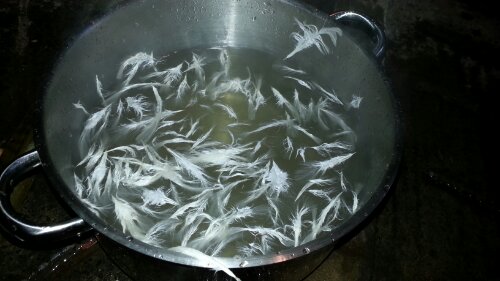
Plucking is another story and for some strange reason I find myself unable to take that on. I can deal with the killing and the butchering later on so perhaps I just need that intervening time to deal with the change from live animal to carcass.
Dip, pluck, repeat…
There are 2 or 3 more unwanted “gentlemen” still with the flock so it’s only a matter of time before they get dealt with too. For the moment, they don’t realise their lucky escape by not perching close to the door of the coop but the clock is ticking for them as well
New year, New start
The start of a new year is always a good time to think ahead to the growing season but as usual I’m way ahead of myself and thinking about the raised vegetable beds already!
A handy coil of old water piping behind a barn was soon put to good use and I’m quite impressed with the results. There is even enough piping left over to deal with a couple more raised beds and even better, a little less rubbish left behind the barn!
I’m not sure where to get the plastic (or netting) to put over this but I’m sure that Google will be able to point me in the right direction. Once that is in place I can see whether there are any noticeable benefits and that might help me decide about getting a greenhouse and/or a polytunnel in future.
Rain stopped play
After the rain set on for the afternoon, the obvious plan was to head for the kitchen and get on with some other jobs.
There was a quick round of sausage making – pork and leek if you’re interested – as we had just about run out over the Christmas period. Due to a miscalculation with the length of sausage casings, I’m left with a supply of sausage meat which will probably be used to make Scotch Eggs or maybe try a “Scotch Egg Pie” recipe I’ve come across.
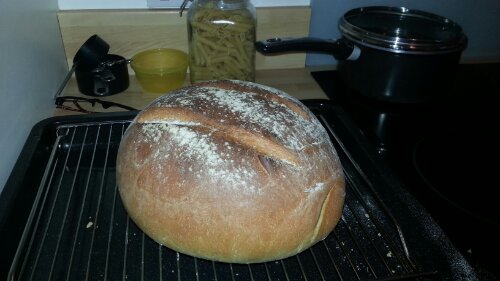
The moment of glory for this afternoons efforts was the loaf of bread though. In my humble opinion a quite spectacular loaf and proof enough for me that I have mastered my basic loaf recipe based on one I found on the New Zealand Kitchen Aid website.
Getting the hand of bread making
All in all, an excellent, productive day and a good start to the new year!
After the good work on the first fallen tree discussed in the previous post, it was time to get working on the second tree. All through the Christmas period it was more a case of “out of sight, out of mind” so the work could be ignored – plus it was not the sort of weather for chainsaw work outdoors and we had a house full anyway!
Today was such a nice day though that there were no more excuses for not getting outside!
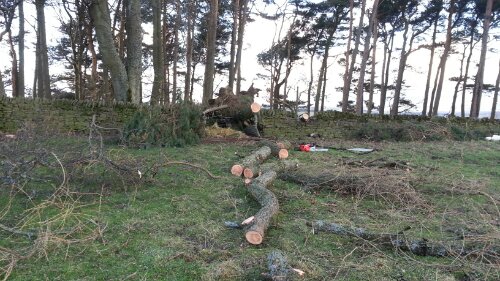
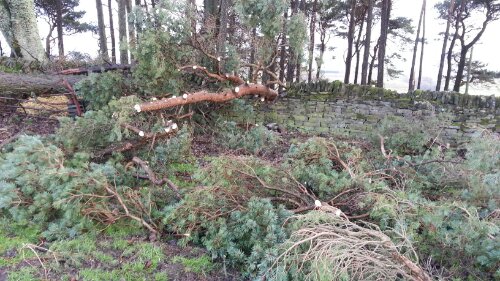
The experience gained when tackling the first tree definitely paid off with this one and it seemed that in no time at all the branches were cleared. The main cuts were easily completed to get the trunk to manageable pieces.
Cutting the trunk down to size
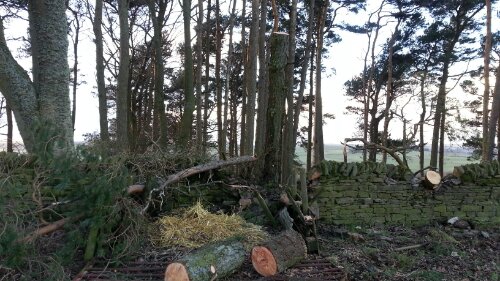
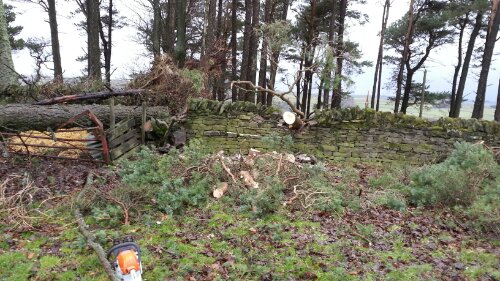
After the previous photo was taken, I moved on to tackle the remaining length of tree trunk which was hanging over the dry stone wall. This was tackled carefully as the trunk was resting on both the wall, an old metal gate and just one side branch.
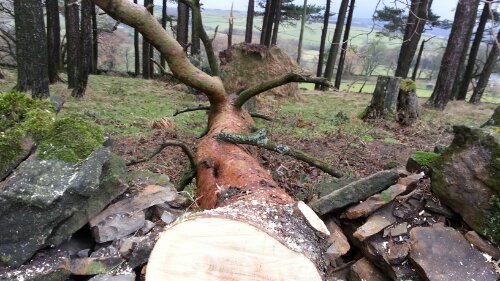
Some sizing up of the situation was followed by a strategic cut in what I thought was a suitably place… however the laws of physics cannot be ignored in the same way that I had ignored the weight of the root ball.
Tree back upright again
It’s not a major problem and there was no risk of injury but it was a little surprising when it happened and another example of the caution needed when working on fallen trees with a chainsaw.
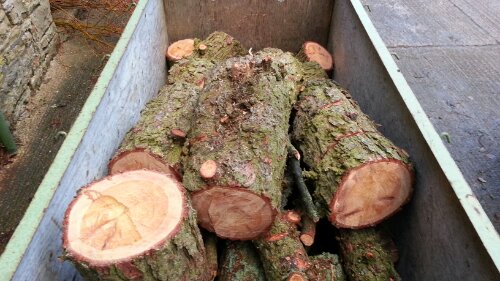
That seems a suitable point to clear up the field especially I could see the clouds looming as the weather closed in. All in all a job well done and luckily the rickety trailer we inherited from the previous owners was up to the job of moving this back to the barn.
A couple of trees came down in the stormy weather at the start of December and just before Christmas I eventually got around to making a start on them. This post is a belated look back at that work now that life is returning to something like normal.
I’m no tree expert but as far as I can tell one is a larch although the other tree is a bit of a mystery to me for the moment – the lack of leaves gives me little to go on. Some proper research will be needed eventually but for now it’s the hard work that needs to be done.
Luckily these two trees only fell across a ramshackle compost heap in the corner of a field and a dry stone wall. The chicken houses are fairly close but well clear of any possible damage from this or future falling trees.
We’ll also need to do some minor repairs to the wall once the trees have been cleared but more importantly I need access to the compost heap when cleaning out the chicken houses!
Side branches mostly cleared
After much effort and careful use of the shiny new chainsaw, the first tree was cleared back to the dry stone wall. A very gratifying amount of progress in a brief spell of dry weather but in the end rain stopped play.
Cleared up to the wall
At first glance, it looks like some good progress was being made but on closer inspection it’s clear that much more of the tree is still there on the other side of the wall!
Not finished yet
First job is to clear the field and compost area while getting the wood into usable sized logs stored somewhere dry. Eventually a log splitter will be needed but hopefully we can borrow one from someone locally for our first attempt!